- The Atomic Builder
- Posts
- Stop Chatting. Start Delegating.
Stop Chatting. Start Delegating.
There are now two ways to work with AI. Most people are still stuck on one of them.

Faisal Shariff
May 12, 2026
Sunday evening. I was in the kitchen making dinner for the family. On the laptop in the other room, an AI was finishing a tool I'd briefed and walked away from earlier. I wasn't watching. The laptop had been running on its own while I cooked.
That was the point.
A few months ago I'd have been at the keyboard the whole time. Asking, getting the answer back, pasting it somewhere else, then trying to make it all fit by hand. I might have missed dinner. Or, more likely, I'd have looked at the calendar, written off the evening, and never built the thing at all.
The infrastructure has been quietly arriving for over a year. The last few weeks are when it crossed into something most knowledge workers can actually pick up. So did how I work.
There are now two distinct ways people are using AI, and a lot of the senior leaders I work with are stuck on one of them without realising it.
You can find out which mode you're in with the diagnostic I built tonight: Chat or Delegate?. Or stay with me. I'll walk you through the thinking, why it matters this month, and how to cross it.
The two modes
There are two distinct ways to work with AI right now, and they're miles apart.

Chat mode is the default. It's also what almost everyone is doing. You open ChatGPT, Claude, or Gemini, type a question, read the answer, copy it into your work, iterate in real time. You stay at the keyboard the whole time. The AI hands you outputs and you become the integration layer between those outputs and the rest of your job.
Most of the AI use I see at work is still this. People treating the smartest thing on earth like Google with better manners.
Delegate mode is what changed. You spend time up front setting context: a brief, the links, examples, sometimes connected tools. Then you hand the AI a task and walk away. It runs, often for tens of minutes to hours, making decisions and calling tools as it goes. You come back to a result rather than an answer. You review the result. The bits that aren't right, you fix. Then it goes where it needs to go. The AI becomes the integration layer. You get your time back.
Here's the cleanest way to know which mode you're in. The Walkaway Test: can you leave your computer for an hour (or a unit of time) while AI works on something meaningful, and come back to a result you can actually use? If yes, you've already crossed the line. If no, the next few minutes are for you.
The mistake most people make is thinking the difference is prompt sophistication. It isn't. Deep Research is chat mode if you're sitting there waiting for it. Voice mode counts as chat too. The fanciest custom GPT or project is still chat mode the moment you stay at the keyboard for it.
The real question is who is waiting for whom.
In chat mode, the AI waits for your next message. In delegate mode, you wait for the AI's next result.
Why this matters this month
The infrastructure for delegate mode has been arriving for over a year. April was when it became hard to miss.
OpenAI's Codex can now operate your computer the way you do. It also runs tasks unattended for hours at a time. And it remembers what you told it last week. The product has more than four million weekly users, up eightfold since January. Two weeks ago they extended it to Chrome. Anthropic released its advisor pattern, where a fast cheap model runs a task and calls in a stronger one only when something hard comes up. Cowork mode, Anthropic's desktop product for non-developers, opens this style of work to anyone who can write a brief.
The shift from chat to delegate used to need a developer's setup. The last few weeks are when that stopped being true for everyone else.
That's why a Sunday afternoon was enough for me to build the diagnostic. The tool went live before dinner. The next section is what that actually looked like.
How I built the diagnostic while making dinner
The diagnostic I refer to is seven questions, sixty seconds to complete, no email required. You get back one of three modes and a specific action to try this week. It's a single mobile-friendly page. Nothing technically clever. The interesting part is what it took to get from idea to live tool in a single Sunday afternoon, with most of the evening still free.
The actual work was thirty minutes of writing, not building. I made three files in a project folder: the context (audience, framework, questions, scoring, result copy, tone), the build brief (tech stack, page structure, deployment), and a premium frontend design system I keep on hand for jobs like this. Then I opened Codex, pasted a single prompt asking it to read the three files and build the thing, and closed the laptop.
Six minutes later, Codex was done. Working diagnostic, all seven questions, scoring, three result pages. Zero clarifying questions on the way through. That was the actual test of the brief. Good context produces no questions.
The result was not perfect. I took the test, got Hybrid, and the body copy didn't fit me. So I sent it back. Three short follow-ups. One tightened the scoring bands and put the actual score on the result page. The Hybrid copy needed gradation for people closer to chat versus closer to delegate. A final pass stripped the remaining insider language ("ship", "agent", "hand off") and turned every action card into numbered steps a non-technical reader could actually use.
Total time at the keyboard across the whole build and reviews: closer to an hour. Agent runtime end to end: under ten minutes. On paper that looks like I did most of the work. But mine was in chunks, fitted around dinner and the family rather than blocking out an evening. The agent's runtime filled a gap.
That is what delegate mode actually buys you: work that fits into the cracks of your day, with real building happening in the gaps you would never otherwise have been able to use. Sometimes the total hours go down too, but that is a bonus rather than the point.
That is the loop. Brief, dispatch, walk away, review, send back with a focused note, repeat. It scales: this build was six minutes of agent runtime, but the same loop works for tasks that run six hours or overnight. The keyboard time barely changes. The model is rarely the limiting factor any more. The work has shifted to the brief you write before you leave the room, and the review when you come back.
The tool is at chat or delegate?. Take it.
Take the test
The diagnostic is seven questions, about sixty seconds, no email required. It tells you which of three modes you're operating in, and the one workflow to move into delegate this week.
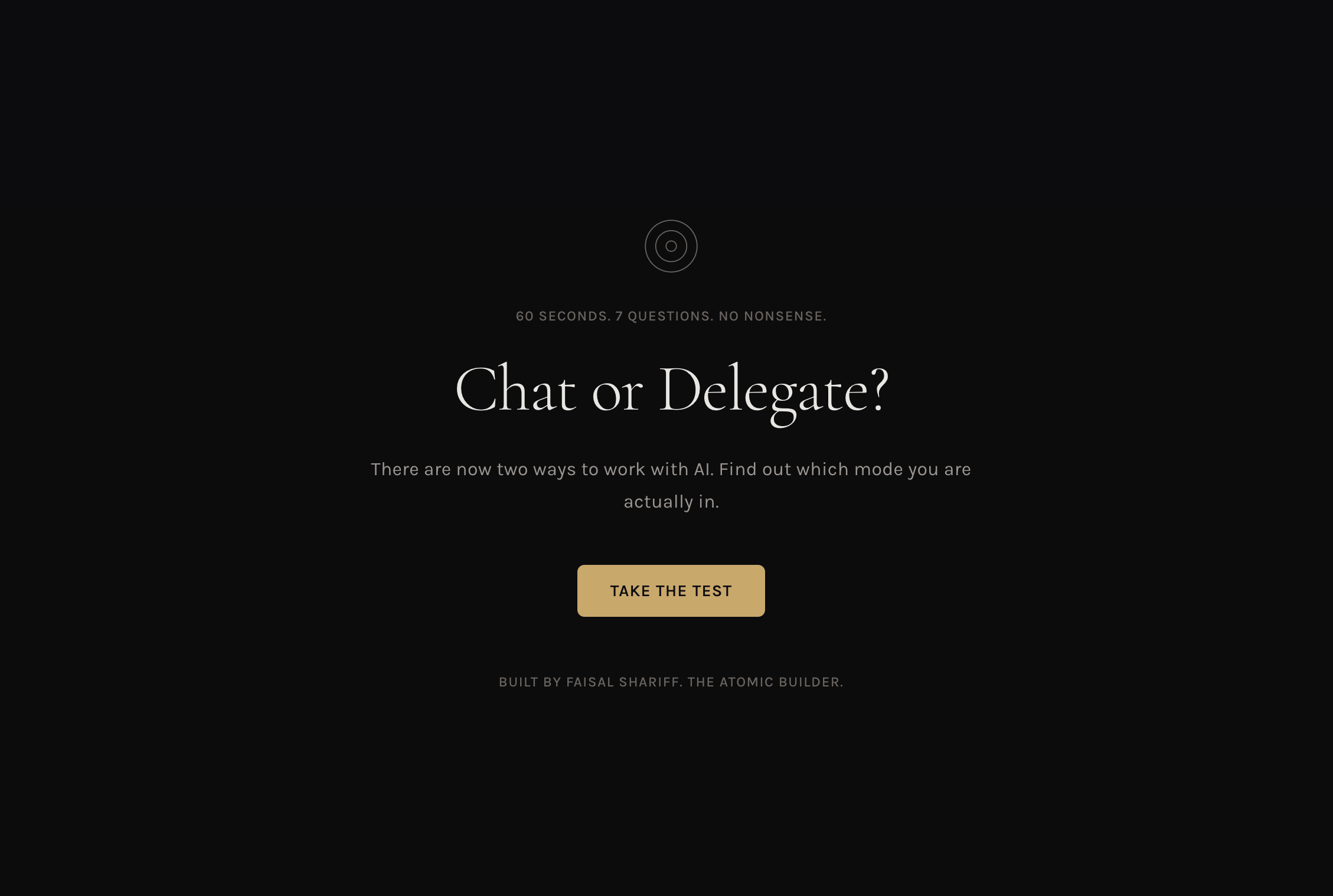
Three of the questions to give you a feel:
How often can you leave your computer while AI works on something meaningful?
Before you give AI a task, how much context do you typically set up?
When AI returns work to you, what is your default move?
The full version is at chat or delegate?.
The cost most people don't price in
Delegate mode is not free. It looks like time-back, and most of the time it is, but there is a tax you don't see until you've been running it for a few weeks.
The first cost is the rework tax. I wrote about this in March. Across the recent McKinsey and Gartner data, about forty percent of the time AI saves you on the task is lost again to fixing what it produces. If your review skills are weak, you end up with worse output and the same hours, plus the cognitive cost of two languages running in your head at once.
The second cost is harder to talk about. I wrote about this last week. People who delegate constantly start drifting from their own work, hitting accept on things they don't really understand. The muscle that made them good at the job starts to atrophy. Don't stop delegating. Just delegate the right things, and review them the way you'd review a colleague's work.
Both of these are reasons to take delegate mode seriously rather than avoid it. The companies and individuals who get this right aren't the ones with the cleverest prompts. They invest in two specific skills: writing a brief the agent can act on without questions, and reading what comes back honestly enough to catch when it's off.
Everything else is execution detail.
What to do tomorrow morning
Pick one task this week that you currently do as back-and-forth chat. Make it something that takes more than thirty minutes and that you actually care about. A weekly synthesis. A meeting prep pack. A draft of something serious. A recurring report you keep meaning to redesign but never do.
Spend fifteen to twenty minutes writing the brief. Be specific about what you want, who it's for, where to find the inputs, and what good looks like. Drop it into Codex, Claude Code, Cowork, or whatever you have. Walk away.
Come back when it's done. Read every line. Fix what's actually off, not what just feels different to how you would have written it.
That is delegate mode.
If you don't know which task to pick, take the diagnostic. It will tell you the workflow most worth shifting first for your current mode: chat or delegate?. See you next week. Faisal |  |
P.S. Know someone else who’d benefit from this? Share this issue with them.
Received this from a friend? Subscribe below.
The Atomic Builder is written by Faisal Shariff, Human Productivity Lead at Tomoro AI. Views are my own.