- The Atomic Builder
- Posts
- The AI You're Paying For vs The AI You're Using
The AI You're Paying For vs The AI You're Using
Why most professionals only use 15% of their tools - and how to close the gap

Faisal Shariff
February 03, 2026
Last week I made the case that smaller companies can out-execute enterprises on AI. But here's the uncomfortable follow-up: that advantage only shows up if the people in those companies actually use what's available to them.
Most professionals I work with are using maybe 15% of the AI capabilities they're already paying for.
That number isn't scientific. It's a gut estimate from dozens of conversations where I've asked people to show me how they actually use these tools day-to-day. The pattern is consistent: email drafting, meeting summaries, the occasional research question. That's often where it stops.
This growing gap between what AI can do and what people are actually doing with it is the equivalent of leaving money on the table. And here's the thing that makes it interesting - the barrier isn't access anymore. Most knowledge workers have Claude Pro or ChatGPT Plus.
The tools are sitting right there. The gap is in how you may be using them.
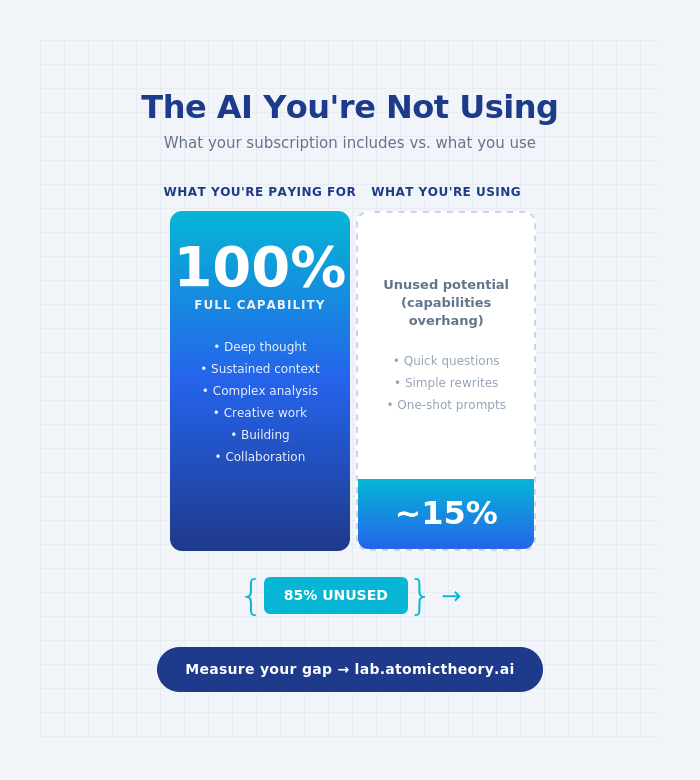
What are you paying for, but not using?
Why the Gap Exists
I don't think this is about laziness or being "behind." It's more fundamental than that.
AI tools don't come with an instruction manual for thinking differently (although frontier labs are making a more concerted effort around education on AI use). We default to patterns we know. If you've spent twenty years writing emails, your first instinct is to use AI to write emails faster. That's completely natural. It's also using a compound AI system like it's autocomplete.
Here's what I keep running into: the capabilities have been moving faster than anyone can track. Twelve months ago, asking Claude to help you build a working prototype would have seemed ambitious. Today it's routine, if you know to ask. But most people don't know to ask, because they're still operating on assumptions from six months ago. In AI terms, that's ancient history.
There's also a real information problem. Not about AI in the abstract, we're literally drowning in that. But about what's specifically possible for your work, with your constraints, in your context. That kind of information is much harder to come by.
Where Are You Actually?
Before you can close the gap, you need to know where you are. Here's a framework I use when I'm working with teams:
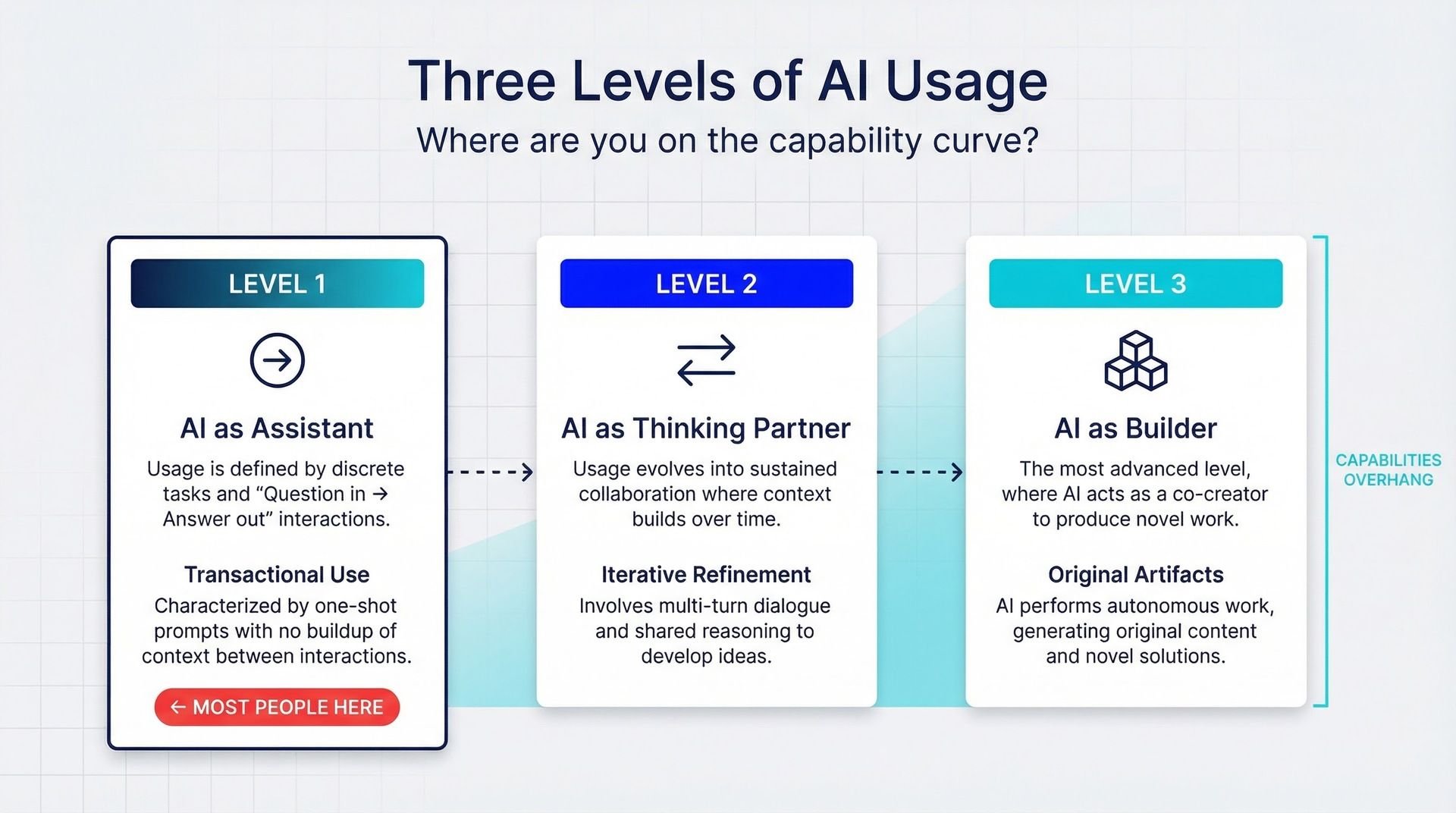
Level 1, 2 or 3?
Level 1: AI as Assistant You're using AI for discrete tasks. Question in, answer out. Write this email. Summarise this doc. The AI responds, you take the output, move on. This is where most people start. It's also where most people stay - not because they're doing anything wrong, but because nothing's pushed them to explore further.
Level 2: AI as Thinking Partner You're working with AI on sustained problems. Iterating on a strategy document over multiple sessions. Using it to stress-test your thinking, not just execute your tasks. The AI has context about your work and builds on it. This is where productivity gains start to compound, but it requires a different mental model, treating AI as a collaborator rather than a tool you query.
Level 3: AI as Builder You're using AI to create things that didn't exist before. Not asking AI to help with your work, but expanding what work you're capable of doing.
Let me make this concrete…
I had an idea for an app. With Ramadan looming, I called it ‘Sohba’ (reply to my email if you’d like to talk through it) - a global platform that uses AI matching to help Muslims find meaningful social connections, starting with Ramadan iftars. Old world: that's months of planning, maybe hiring a developer, definitely not something I'd attempt as a side project. Instead, I built a working prototype (not just a landing page) in 24 hours. Put it in front of people. Got feedback that existing options, probably already serve this need well enough. Idea tested. Lesson learned. Total time invested: one day.
That's the shift. Not just doing existing work faster. Changing what's possible to attempt and what's possible to learn before you've over-invested.
Most professionals I meet are firmly at Level 1, occasionally dipping into Level 2. Almost none have explored Level 3, even when the subscription they're already paying for includes it.

Fully working concept, live on the internet with authentication and database, built in 24 hours
The Leverage Question
This isn't about keeping up with AI trends. (Honestly, trying to "keep up" is exhausting and probably counterproductive.)
It's about leverage. Specifically: what you become capable of when you close your own gap.
A product manager who can prototype before involving engineering. A consultant who can build custom tools for clients instead of just handing over slide decks. A founder who can ship an MVP without a technical co-founder. A marketing lead who spins up landing page variants and tests them the same afternoon.
Skills that took years to develop can now be augmented in hours. That's not a threat if you're the one doing the augmenting. It's leverage - the kind that compounds the more you use it.
The professionals who close their capabilities gap don't just get more productive. They get more valuable, because they can do things that weren't previously possible for someone in their role.
Testing Where You Are
If you want to close your own gap, don't start by reading more about AI (but do get to the end of this article). Start by testing what's actually possible right now.
I built something for exactly this: five experiments at lab.atomictheory.ai. Each one is designed to surface a capability you're probably paying for but not using.
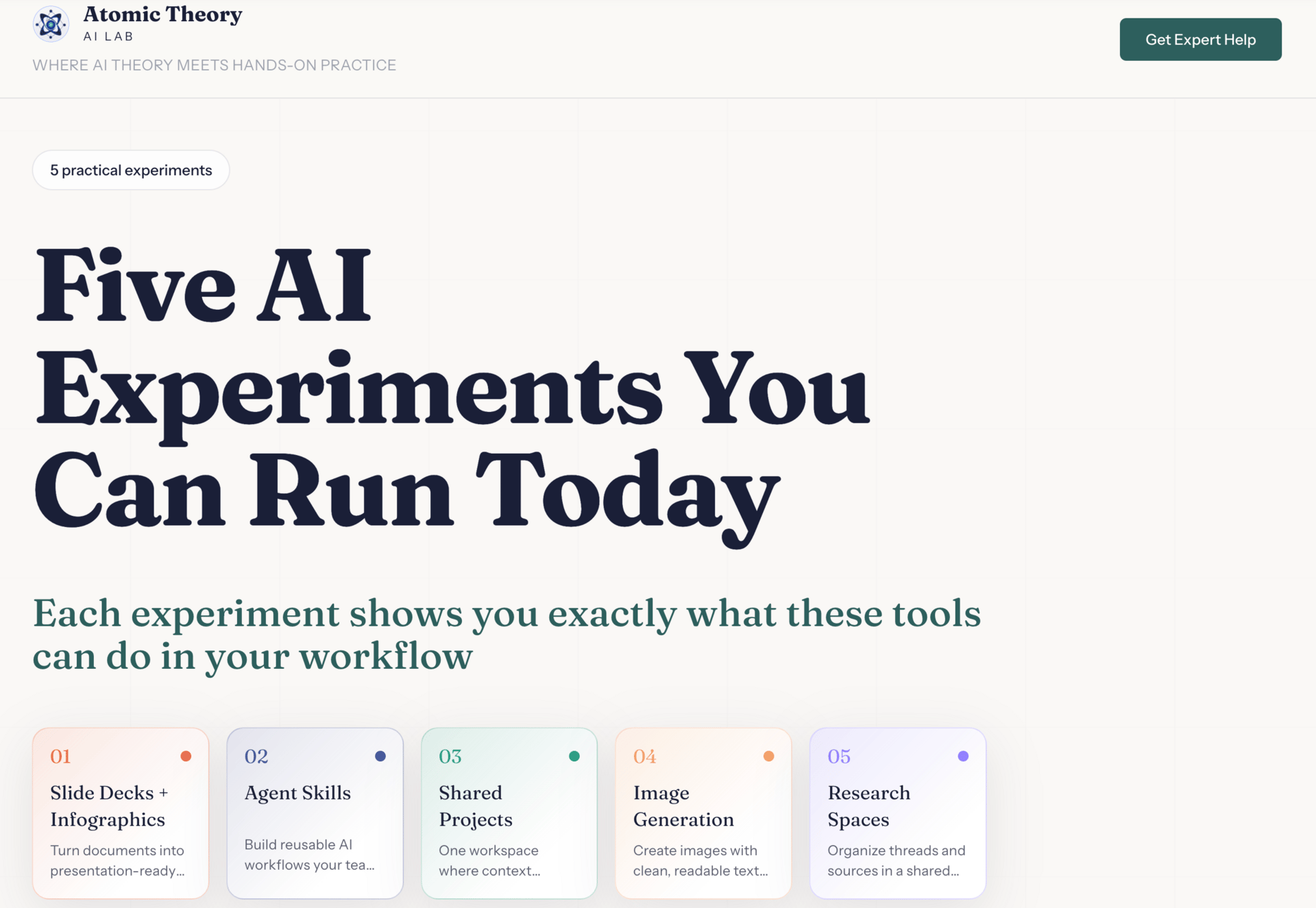
One example: the NotebookLM experiment takes any document you have - a strategy deck, a research report, whatever - and turns it into presentation-ready slides or a visual infographic in about minutes. Most people I show this to had no idea it was possible. Capability you can use today.
Another: the Claude Skills experiment (skills are becoming an increasingly powerful part of the Anthropic platform). You teach Claude how you work in terms of a specific output you need - your review process, your brand voice, your formatting conventions - and then it applies that playbook automatically to future requests that require it. Takes about five minutes to set up. Most people don't know this exists, even if they're paying for Claude Pro.
The point isn't to master every tool. It's to update your mental model of what's possible, so you can make better decisions about where to invest your time.
Tomorrow Morning Action
Go to lab.atomictheory.ai.
Pick one experiment. Spend thirty minutes with it this week. Not reading about it - actually doing it.
That's worth more than any amount of reading about AI capabilities. Because the gap isn't going to close itself, and every month it gets a little wider as the tools keep advancing while usage patterns stay static.
See what happens. Then decide what's worth going deeper on.
That's how you start closing the gap.
If your team is wrestling with where to start on AI, or how to move from pilots to real adoption, that's what I help organisations figure out. Reply and let's talk. See you next week. Faisal |  |
P.S. Know someone else who’d benefit from this? Share this issue with them.
Received this from a friend? Subscribe below.
The Atomic Builder is written by Faisal Shariff and powered by Atomic Theory Consulting Ltd - helping organisations put AI transformation into practice.