- The Atomic Builder
- Posts
- The First Five Minutes of Vibe Coding Are Broken
The First Five Minutes of Vibe Coding Are Broken
Vibe coding platforms fail the people who need them most. Three design changes that would fix them.

Faisal Shariff
February 17, 2026
Today, I'm breaking down why vibe coding platforms lose non-technical users before they ever build anything, and the three design changes that would fix them. Tomorrow, I'll share what happened when I actually built a solution and what you should consider, if you’re starting with these tools.
I've built over 25 apps since 2025 across Lovable, Bolt, Replit, Cursor, Google AI Studio and Claude Code. I'm not a developer. I'm a product manager who discovered that AI tools have made it possible for people like me to build real, working software through conversation.
But here's what I keep bumping into: every single one of these platforms assumes you already know what you’re doing.
Open Lovable. Blank text box. "Describe your app." Open Bolt. Same thing. Open Replit. Same. Claude Code in the Desktop App? Same. If you don't already think in terms of apps and features and technical requirements, these opening screens are currently a wall, not a door.
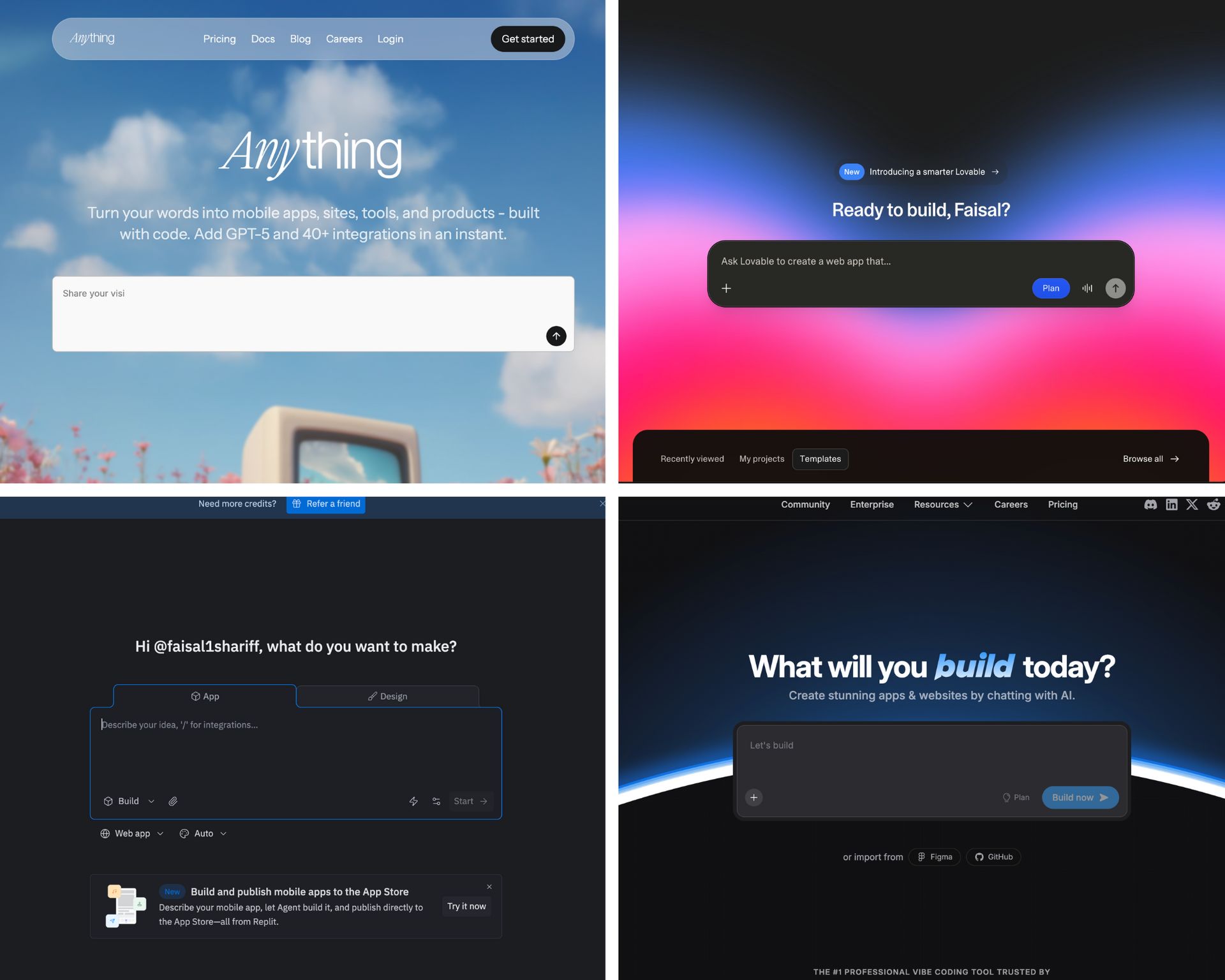
From top left clockwise: Anything, Lovable, Bolt, Replit
And that's a problem, because the biggest growth opportunity in vibe coding isn't developers. It's the millions of people who might build things if someone designed the first five minutes for them. The challenge that a million more apps in the world creates, is frankly a problem for another day. We're not here to debate that today.
These systems are currently a wall, not a door
The blank prompt problem
Every vibe coding platform starts with some version of "What do you want to build?" That question assumes three things: you know what's possible, you have a clear idea, and you can describe it in terms the AI can work with. Most non-technical people can't do all three.
This isn't a complaint about the tools. They're extraordinary once you're inside the build process. The issue is the introduction to them. The moment a small business owner, a teacher, a marketing manager, or a consultant lands on one of these platforms, they're met with an experience designed for someone who already has a mental model of software development.
I've watched this happen in real time. I run workshops where I introduce people to vibe coding tools. The most common reaction when they first see the interface isn't excitement. It's hesitation. "What do I type?" "Am I doing this right?" "What if I ask for the wrong thing?" The tools are powerful. The entry point is intimidating.
"What do you want to build?"
Three changes that would open the door
I've been prototyping what a better first experience looks like. I built a concept called Compass (below), a guided layer on top of Claude Code that walks non-developers through the entire process from idea to working app. The exercise taught me that you only need to fix three things to solve that friction in the first 5 minutes.
Start with who the user is, not what they want to build.
Instead of a blank prompt, ask "What do you do?" and offer clear options: I run a business, I work in marketing, I teach or train, I make things for clients. Use that context to show tailored ideas. "Here's what business owners are building: a tool to track which clients owe you money, a booking page where customers pick a time slot, a dashboard showing today's sales and tasks." The user goes from "I don't know what to type" to "oh, that one" in seconds. You've replaced a blank page with a menu.
Never leave the user staring at a cursor.
Every question the platform asks should come with tappable suggestion pills, contextual options the user can pick instead of typing. Not autocomplete. Actual suggested answers that move the conversation forward. "Should people need to log in?" with pills for "Yes, each person sees their own stuff" and "No, it's just for me." You're translating technical decisions into human ones. Lovable does a version of this at the start, but nobody carries it through the full experience. The moment you stop offering suggestion pills, you're back to assuming the user knows what to say.
Show before you build.
Before generating any code, show the user a visual preview of what their app will look like. Wireframes. Sketches. Something they can point at and say "yes, that" or "no, change this." This is the confidence moment. Non-technical users can't evaluate a text description of an app ("Your app will have a sidebar navigation with three views"). But they can look at a picture and tell you whether it's right. Show them the wireframe first, get approval, then build. You've given them the confidence to say "go" because they can see what they're agreeing to.
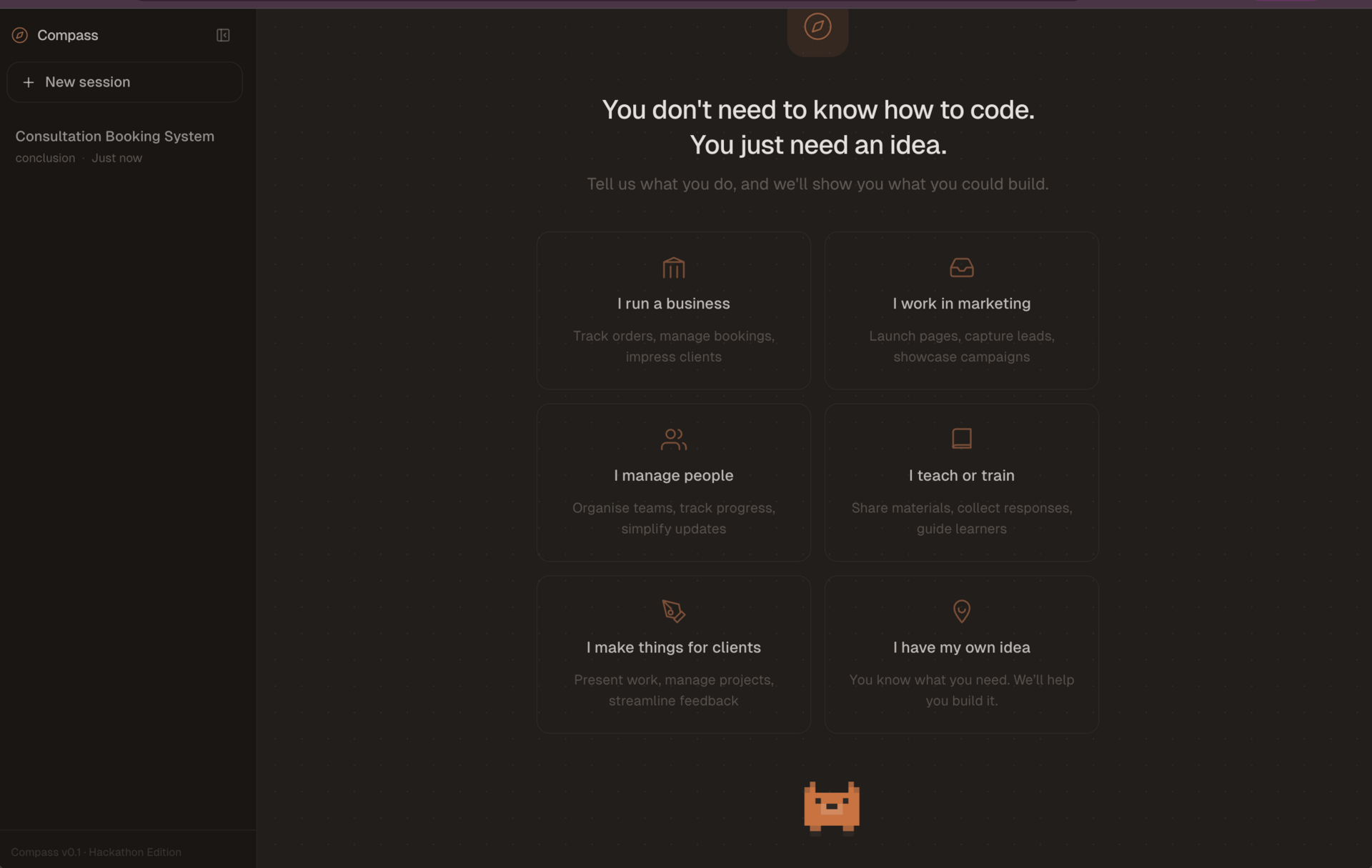
The Compass prototype: ‘Tell us what you do’ - the key unlock
This isn't an engineering problem
None of these changes require new AI capabilities. The models can already do all of this. It's a product design problem. The teams building these platforms are, understandably, technical themselves. They're solving for their own mental model. But the next hundred million users of these tools won't share that mental model. They need a different entry point.
I built Compass on top of Claude Code, a tool that currently has essentially zero non-technical users, specifically to prove the point at the extreme end. If you can make Claude Code accessible to someone who's never used it, the same principles work everywhere.
What this means for you
The tools don't support this workflow natively today. But if you understand how to work with them, you can get most of the way there. Structuring your prompts with context about who you are, asking the AI to suggest options rather than waiting for you to describe everything. These are techniques I use every time I build something, and they work across every platform I've tested.
If you're someone who's been curious about building with AI but felt put off by the blank prompt, the barrier isn't you. It's the first five minutes. And those five minutes are fixable.
If you're in a position to help others in your organisation start building, whether that's your team, your clients, or your community, this is the gap I help people bridge. I run workshops that take people from "I wouldn't know where to start" to launching their first app. Because the tools are ready. The missing piece is someone who speaks both languages.
Tomorrow: I'll walk through what it was actually like to build Compass, the planning, the friction, and why your words matter more than your code. And you'll be able to try it for yourself. Faisal |  |
P.S. Know someone else who’d benefit from this? Share this issue with them.
Received this from a friend? Subscribe below.
The Atomic Builder is written by Faisal Shariff and powered by Atomic Theory Consulting Ltd — helping organisations put AI transformation into practice.